

A piece of artwork featuring swirling water textures and shapes in varying shades of blue and teal
Art by Brandy May Bouré
Tribal Guide to Maritime Washington logo

Since time immemorial, Native peoples have woven relationships with—and across—Washington’s saltwater shores.

They have crafted fishing weirs, reef nets, and clam forks, among other technologies, to harvest abundant saltwater fisheries. They have practiced song, dance, and storytelling to maintain cultures. They have carved canoes and paddles to support long-standing trade and kinship networks throughout the region.

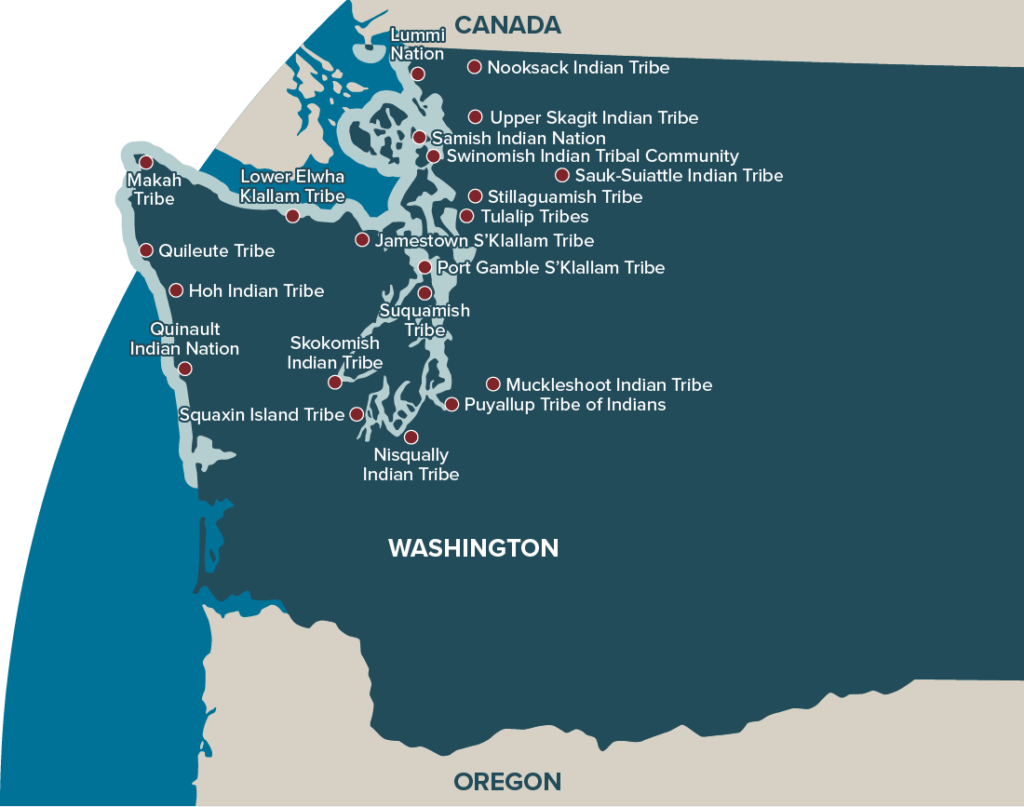
Today, the Maritime Washington National Heritage Area includes the ancestral lands and waters of twenty-one federally recognized Tribal nations. Discover the rich maritime heritage of Washington’s Tribal nations through the Tribal Guide to Maritime Washington.

Map locations represent Tribal headquarters.

Invitation to Embark

Join us as we navigate through Indigenous Maritime Washington. Together, we’ll traverse the ancestral highways and shorelines that have sustained Tribal nations since time immemorial. Learn from the Tribes who have contributed to the guide so far—and keep checking back for new additions.

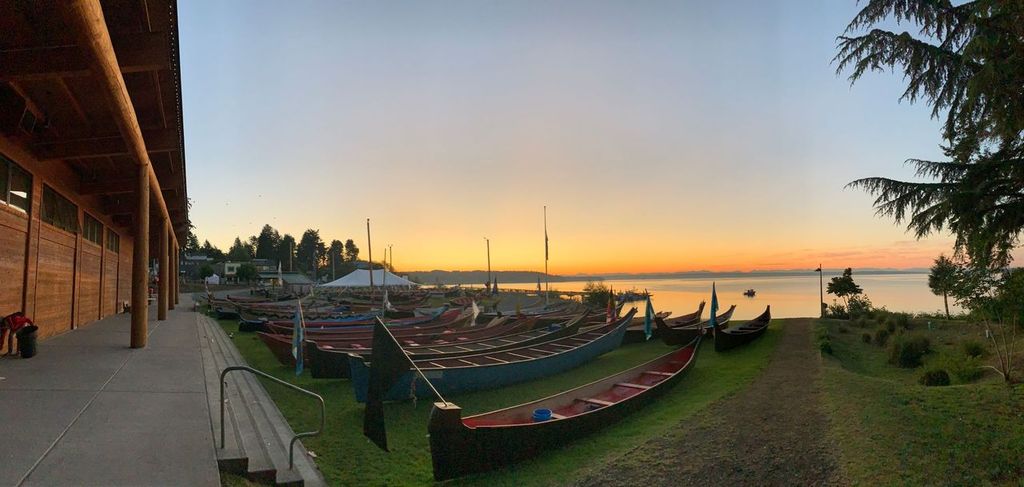
Several canoes laid on the lawn in front of a wooden building, set against sunset over the water.

Suquamish Tribe

The Suquamish people have navigated the waterways of the x̌ʷəlč (a Lushootseed word for the Salish Sea) for thousands of years. Traveling by dugout canoe, the Suquamish have sustained relationships with relatives at ancestral villages as widespread as Indian Island, Quilcene, Olalla, Seattle, and beyond. Nourished by abundant shellfish, kelp, and bounties of land and sea, the Suquamish maintain vibrant communities along the x̌ʷəlč today.

Project Background

The Tribal Guide to Maritime Washington is a platform for sharing stories of Indigenous maritime heritage across Washington. The guide highlights the deep relationships between peoples and sea that have shaped this region for thousands of years.

Indigenous peoples are too often treated as part of the distant past. But Native communities remain deeply connected to Washington’s waterways today, despite centuries of colonization and displacement. The Tribal Guide shares a selection of these living relationships and the cultural practices that sustain them.

The guide is organized as a series of webpages, each dedicated to a Tribal nation within the Maritime Washington National Heritage Area. Each page was created through collaboration between the Tribe and Maritime Washington. Together, we collected perspectives on fishing, shellfish harvesting, canoes, and other aspects of marine-based culture. We then recorded and prepared these perspectives for a public audience. More Tribes will be added to this website as collaborations continue.

The result is a curated collection of Indigenous perspectives shared by Indigenous people. Together, they reveal a diverse and interconnected maritime world that both predates and continues beyond non-Native settlement in Washington.

Acknowledgments

Project Team

Alex Gradwohl, Washington Trust for Historic Preservation

Dr. Joshua L. Reid, Center for the Study of the Pacific Northwest, University of Washington

Dr. Meagan Harden, Mellon Humanities Program

Dr. Perri Meldon, Mellon Humanities Program

Dr. Eleanor Mahoney, Mellon Humanities Program

Dr. Helen LaCroix, Mellon Humanities Program

Jessica Dauterive, Mellon Humanities Program

Michael Faist, Mellon Humanities Program

Cait Johnson, Mellon Humanities Program

Gail Chehak, American Indigenous Tourism Association

Lorraine Gala Lewis, American Indigenous Tourism Association

Bruce Rettig, American Indigenous Tourism Association

Pilot Project Partners

Suquamish Tribe

Squaxin Island Tribe

Web Design

Alex Domine, JayRay

Julia White, JayRay

This Tribal Guide was made possible thanks to generous support from the following partners:

American Conservation Experience logo
M.J Murdock Charitable Trust logo