

Boaters can “be whale wise” and help protect critically endangered orcas by following a new set of guidelines. Here’s what you need to know.
By Clare Ogle and Conor Agnew, Be Whale Wise
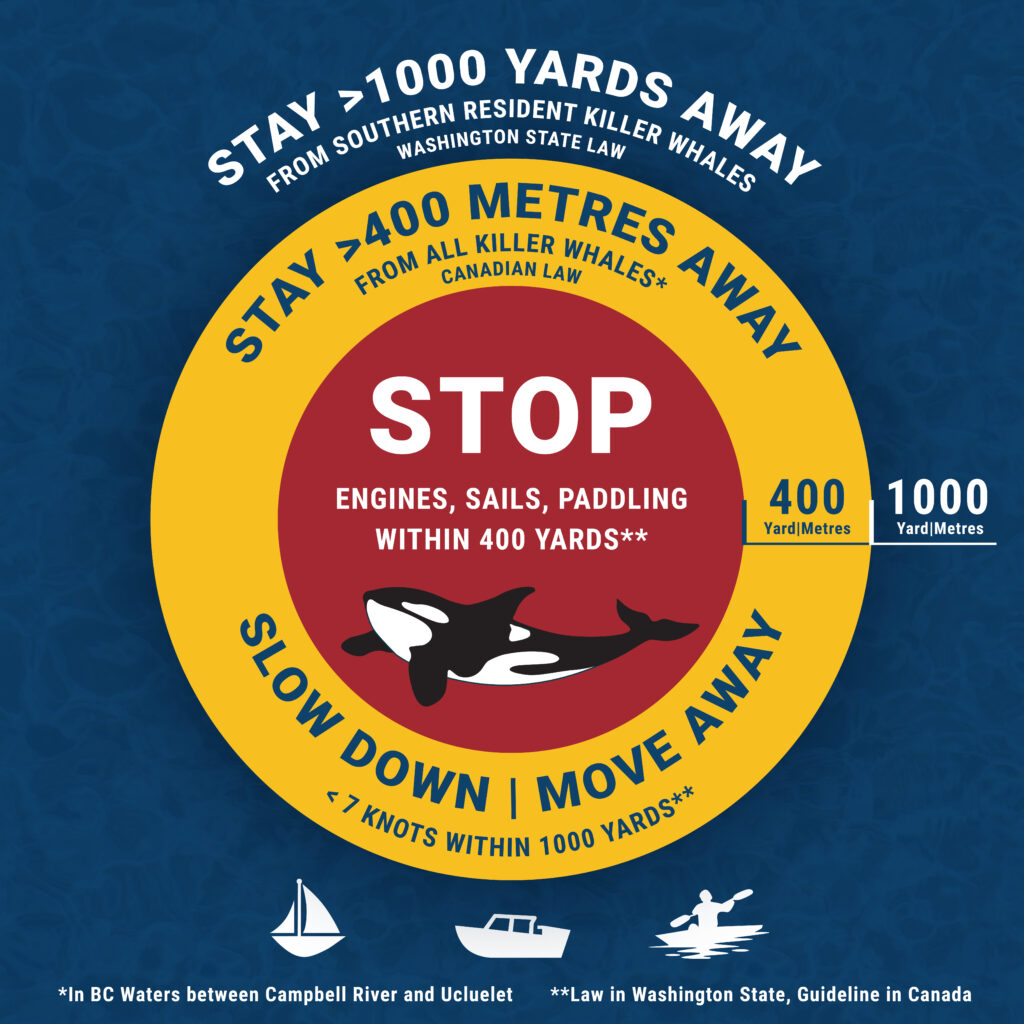
In January 2025, new orca distancing regulations went into effect in Washington state waters. Boaters are now required to stay 1,000 yards away from Southern Resident killer whales, a significant expansion from the previous distance. Additionally, if a Southern Resident approaches within 400 yards, boaters must stop moving until the animal moves away.
This change was the result of a bipartisan effort in the Washington State Legislature in 2023 to better align with new scientific research on the importance of vessel distance in Southern Resident killer whale recovery.
Threats to Southern Resident Killer Whales
These efforts come at a time when the Southern Resident killer whale population is at its lowest point in 30 years. As of the last official census in July 2025, there are 73 living members of this endangered species. The survival and recovery of the Southern Resident population remains a challenge.
There are three key threats to Southern Resident killer whale recovery: vessel disturbance, prey availability, and pollution.
Southern Residents use echolocation to hunt and communicate, with senses so finely tuned that they can tell different species of salmon apart by the distinct acoustic signature of the fish’s air bladders. They use this information to hunt primarily Chinook (also known as King) salmon.
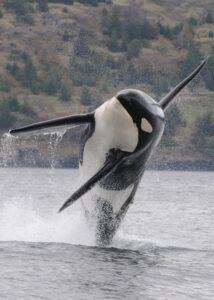
However, echolocation becomes significantly more difficult when there are vessels creating noise nearby, because the same frequencies used by Southern Resident killer whales to communicate and echolocate overlap with the frequencies produced by large cargo and tug vessels or small recreational vessels, respectively[1][2]. Research has shown that a one decibel increase in noise level increases the amount of time Southern Residents spend searching for prey and decreases the likelihood of the whales both pursuing and catching prey[3]
As the availability of Chinook salmon declines, the Southern Resident’s ability to successfully forage the salmon that remain is essential. Puget Sound Chinook salmon, which are currently listed as “threatened” under the Endangered Species Act, are only about one-third as abundant as they were in the early 1900s.
Expanded distancing regulations for vessels are just one part of improving the quality of life for existing Southern Residents, but they are a vitally important one. By following the regulations and guidelines, boaters do their part to ensure Southern Residents can successfully hunt, play, and explore.
So, What Can I Do as a Boater?
In Washington:
- Boaters must stay 1,000 yards* from Southern Resident killer whales.
- Boaters must go slow (<7 knots) and move away if within 400 to 1,000 yards of Southern Resident killer whales.
- Boaters must disengage engine(s) if Southern Resident killer whales appear within 400 yards.
- Boaters must stay 200 yards from other killer whales (Bigg’s/Transient killer whales).
- Boaters must not park in the path within 400 yards of other killer whales (Bigg’s/Transient killer whales)
In Canada:
- Boaters must stay 400 metres away and may not position a vessel in the path of killer whales in southern BC coastal waters between Campbell River and just north of Ucluelet until May 31, 2025, as per the Interim Order enacted under the Canada Shipping Act.
- Boats must stay 200 metres from all killer whales in other Canadian Pacific waters and from all whales, dolphins, or porpoises if they are resting or with a calf.
- Boats must stay 100 metres from all other whales, dolphins, and porpoises in Canadian Pacific waters.
- Drones can disturb marine mammals, so are discouraged for viewing marine mammals unless appropriate permits are obtained.
Follow Be Whale Wise Guidelines:
These guidelines apply to all whales, porpoises, dolphins, seals, sea lions, any animal hauled out, and nesting birds.
- KNOW BEFORE YOU GO. Educate yourself on local marine life and regulations before getting underway.
- BE ALERT AND CAUTIOUS on the water. Have your family and friends help to scan for nearby marine life, especially in areas with known or suspected marine wildlife activity, or in narrow or tight areas of navigation.
- LOOK IN ALL DIRECTIONS and ALWAYS GO SLOW (<7 knots) when in the vicinity of any marine wildlife. If you suspect but aren’t certain marine wildlife are near, slow to a stop and assess the situation.
- PLACE ENGINE into neutral and allow all animals space to pass if they approach your vessel or surface within the allowable distance.
- BE PREPARED to move away or shut down if nearby animals change speed and/or direction.
- DO NOT position your vessel in front or behind wildlife.
- STAY on the OFFSHORE side of all wildlife to lessen disturbance along the shoreline.*
- AVOID moving through and disturbing groups of any marine animal. DISCOURAGE bow or stern riding by holding course and gradually reducing speed.
- LIMIT any wildlife viewing time to 30 minutes or less to lessen cumulative impact of vessels on wildlife.
- NEVER approach an animal in distress. Contact your local marine mammal response network to report a sick, stranded, entangled, or dead marine animal.
- DID YOU SEE A WHALE? Help fellow boaters Be Whale Wise by flying your Whale Warning Flag and reporting your sighting to your local sightings network.
* Kayakers and paddlers should follow the Kayak Education Leadership Program (K.E.L.P.) guidelines to stay INSHORE of wildlife, raft up, secure themselves, and stop paddling until whales have passed beyond regulation distance. Never paddle towards whales.
To learn more, visit the Be Whale Wise website at bewhalewise.org!
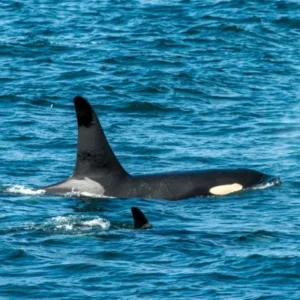
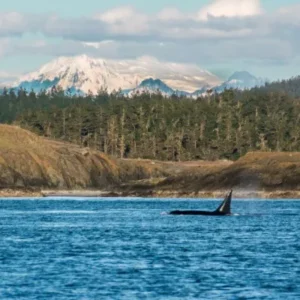
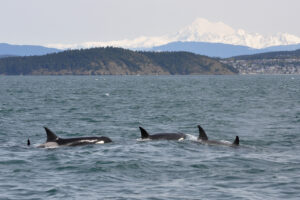
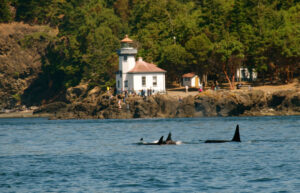
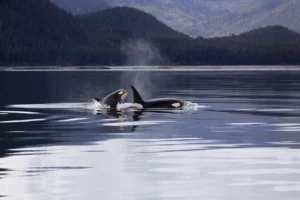
Outreach in Progress
Be Whale Wise is a partnership of county, state, and federal governments; researchers; non-profits; and other stakeholders working together to provide information and education on the regulations and guidelines for marine wildlife, but especially for Southern Resident killer whales. The partnership conducts education and outreach both in-person and digitally throughout the Salish Sea. They also produce and distribute materials—including regulatory signage—with the goal of ensuring boaters are aware of the new regulations and ready to enjoy the water with confidence.
Additionally, the Boater Ambassador Program, an initiative coordinated by WDFW and The Whale Museum, launched earlier this year to reach boaters all around the Salish Sea to share materials and information about the new regulations. This innovative program was developed collaboratively with input from boaters, regulators, nonprofit organizations, and prospective volunteers. The program’s work was carried out by a group of volunteer ambassadors who have strong connections to the boating or marine science community.
On-water education and mitigation efforts continue through the Soundwatch Boater Education Program based in Washington and the Straitwatch program based in British Columbia. In 2024, Soundwatch and Straitwatch South (the southern branch of the Straitwatch program) reached approximately 4,500 boaters on the water, educating them before incidents occurred and mitigating the effects of vessel disturbance on wildlife.
These combined regulatory and educational efforts are essential for giving the Southern Residents the best chance at recovery and growth. There are many actions you, as a boater, can take to contribute to the conservation of the Southern Resident killer whales!
Works Cited:
[1] Burnham, R. E., Vagle, S., Thupaki, P., & Thornton, S. J. (2023). Implications of wind and vessel noise on the sound fields experienced by southern resident killer whales Orcinus orca in the Salish Sea. Endangered Species Research, 50, 31-46.
[2] Heise KA, Barrett-Lennard LG, Chapman NR, Dakin DT and others (2017) Proposed metrics for the management of underwater noise for southern resident killer whales. Coastal Ocean Report Series (2). Ocean Wise, Vancouver, p 30
[3] Tennessen, J. B., Holt, M. M., Wright, B. M., Hanson, M. B., Emmons, C. K., Giles, D. A., … & Deecke, V. B. (2024). Males miss and females forgo: Auditory masking from vessel noise impairs foraging efficiency and success in killer whales. Global Change Biology, 30(9), e17490.